So, you've started signing. You've had a few lessons, you've perhaps met some Deaf BSL users. You're keen on the language and you want to learn more. What's next?
Well, there's a whole load of online resources you can use. Bristol University has the fabulous Centre for Deaf Studies (I blogged about it here) and they have a whole host of resources for you:
Deafstation - for people fluent in BSL, providing daily news and information (in BSL) - if you're just starting to learn and you watch this don't get too worried if you don't understand it all. You'll get there I promise!
Signstation - For people learning BSL. It has video, pictures and information about BSL, Deaf people at work and Deaf awareness. A really useful resource for people at level 1 and level 2.
Mobile Sign - a video dictionary with over 5000 signs. For people who work with Deaf people, have Deaf customers or want to learn how to sign. You access the dictionary from a mobile phone phone and download the signs required.
Deafresource - Provides information on the Deaf Community, sign language and Deaf Studies.
VOGS - It provides guides for working with Deaf people covering topics such as using Interpreters, facts about Deaf people and sign language and frequently asked questions. VOGS means 'Vocational Guidance Standard Model for Deaf People'.
VOGS is more of a professional resource, but have a look round them all and see if you think anything's useful.
But wait! There's more!
Signs of God - Signs for use in a Christian setting
Christain Signs - as above. There is a Deaf church, would ya believe it.
Science Signs - for a science education
Signhealth - the healthcare charity for deaf people
Forest Books - selling all sorts of books about the Ddeaf and hard of hearing world. Fiction, academic theories, language books, help for professionals working with Ddeaf people, technology. journals, teaching aids, loads of stuff. It's fabulous.
Deafread - the best of deaf blogs and vlogs from around the world.
Surrounding Deaf culture, there's the Deaf poet Dorothy Miles, who creates and performs poems in BSL, the Deaf comedian John Smith, performing routines in BSL, and Lee's BSL Songs.
You can also check out my Deaf sites and resources post for more links.
I hope this has all been helpful to you and that you've enjoyed the series.

Showing posts with label Learn to Sign week. Show all posts
Showing posts with label Learn to Sign week. Show all posts
Sunday, October 24, 2010


Saturday, October 23, 2010
Learn to Sign week
Hmm, yes I never did finish off those series of posts did I? Well, let's have a go at finishing them now shall we.
If you are in a workplace or a learning centre (like a school, college or university) where you are likely to work with or alongside a Deaf, deaf or hard of hearing person, you will need to think about your communication methods and whether it's appropriate to bring in additional communication support.
How do you decide this? You ask the Deaf/deaf/hard of hearing person if they want extra support, and what they want. You do not assume what they need.
Examples of support may be an interpreter or communication support worker, a lipspeaker or a notetaker. Notetakers can use different types of equipment or different methods to record what is being said.
As for the difference between an interpreter and a communication support worker (csw), well the main difference is qualifications. Note that qualifications and experience are not the same thing. I jokingly say that terps are better qualified, better paid and get more respect..but it's not always that way! CSWs generally work in educational settings whereas terps will work in medical settings, in the workplace, in the courts, loads of places. When you see someone signing at a conference they may be a terp or a CSW. At the end of the day we all facilitate communication between the Deaf world and the hearing world. And we all do our best.
Note: when using terps or csws please remember to look at the Deaf person, and not the terp/csw. All the terp/csw is doing is interpreting the information, they are not speaking for the Deaf person.
For more information about finding a language service professional you can start by looking at the NRCPD website - National Registers of Communication Professionals working with Deaf and Deafblind people. You won't find CSWs on there - if you do specifically want a CSW try your local Deaf club who should have information on how to find one.
If you are in a workplace or a learning centre (like a school, college or university) where you are likely to work with or alongside a Deaf, deaf or hard of hearing person, you will need to think about your communication methods and whether it's appropriate to bring in additional communication support.
How do you decide this? You ask the Deaf/deaf/hard of hearing person if they want extra support, and what they want. You do not assume what they need.
Examples of support may be an interpreter or communication support worker, a lipspeaker or a notetaker. Notetakers can use different types of equipment or different methods to record what is being said.
As for the difference between an interpreter and a communication support worker (csw), well the main difference is qualifications. Note that qualifications and experience are not the same thing. I jokingly say that terps are better qualified, better paid and get more respect..but it's not always that way! CSWs generally work in educational settings whereas terps will work in medical settings, in the workplace, in the courts, loads of places. When you see someone signing at a conference they may be a terp or a CSW. At the end of the day we all facilitate communication between the Deaf world and the hearing world. And we all do our best.
Note: when using terps or csws please remember to look at the Deaf person, and not the terp/csw. All the terp/csw is doing is interpreting the information, they are not speaking for the Deaf person.
For more information about finding a language service professional you can start by looking at the NRCPD website - National Registers of Communication Professionals working with Deaf and Deafblind people. You won't find CSWs on there - if you do specifically want a CSW try your local Deaf club who should have information on how to find one.
Tuesday, October 05, 2010
Where to learn BSL and what to expect
There are a lot of places you can learn BSL. To locate a course you can contact your local deaf club (google the name of a major town near you and deaf club), look at the adult education prospectus or look on Signature's website for a list of all all accredited training providers.
What can you expect when learning BSL?
Well, typically, you will start by doing a level 1 course and you will learn the basics - fingerspelling, places, things in the house, work vocabulary, colours, weather, holidays, animals, and basic grammar. You may be taught by a Deaf BSL user or by a hearing person with a good knowledge of BSL. In the classes you can expect to go over new vocabulary each week, produce stories, and chat with others in your class. All this should be done in BSL with your voice turned off.
You may then do a bridging course, which will improve your skills to nearer that of a level 2 class. After that you can take the level 2 qualification, this will build upon your vocabulary learnt in previous courses, expand your knowledge and ability to use BSL grammar, try to move you away from using Sign Supported English (BSL signs produced in English word order), improve your receptive skills and increase your confidence. It now becomes more important to turn your voice off and to use BSL in each class. Once you have your level 2 you will be able to hold a conversation with a BSL user.
Once you have achieved your level 2, you need to use your BSL regularly and try to mix with Deaf people in order to improve your productive and receptive skills. The next stage is a level 3, and typically you will have spent at least one year if not two practicing your skills and using them regularly. There is a huge jump between the level 2 and level 3 and to help you improve your knowledge you may want to consider doing a pre level 3 course. This is where I am at now, and I can honestly say that the pre level 3 course I took was invaluable and worth every penny I spent. Without being in a formal classroom situation you won't realise what bad habits you have picked up and what it is that you don't know.
After you have achieved your level 3, you will definitely have a good handle on the language and be able to explain and communicate complex ideas in BSL, not SSE. Next up is the level 6 which will take you to interpreter standard.
When you are learning it is important to practice outside the classroom as much as you can. You can do this with friends on your course, or go to coffee mornings or other practice sessions at your local deaf club. You may want to go to interpreted theatre performances to improve your receptive skills, or you can watch the BSL interpreted news on BBC news 24 at 8.30 am and 1pm (I think). See Hear is a good programme about the Deaf Community that is viewable both on BBC 2 and the i-player, if like me you don't watch TV. Like any other language, it is important to learn about the culture of the people who use BSL as it will help you to understand ideas and structure within the language.
What can you expect when learning BSL?
Well, typically, you will start by doing a level 1 course and you will learn the basics - fingerspelling, places, things in the house, work vocabulary, colours, weather, holidays, animals, and basic grammar. You may be taught by a Deaf BSL user or by a hearing person with a good knowledge of BSL. In the classes you can expect to go over new vocabulary each week, produce stories, and chat with others in your class. All this should be done in BSL with your voice turned off.
You may then do a bridging course, which will improve your skills to nearer that of a level 2 class. After that you can take the level 2 qualification, this will build upon your vocabulary learnt in previous courses, expand your knowledge and ability to use BSL grammar, try to move you away from using Sign Supported English (BSL signs produced in English word order), improve your receptive skills and increase your confidence. It now becomes more important to turn your voice off and to use BSL in each class. Once you have your level 2 you will be able to hold a conversation with a BSL user.
Once you have achieved your level 2, you need to use your BSL regularly and try to mix with Deaf people in order to improve your productive and receptive skills. The next stage is a level 3, and typically you will have spent at least one year if not two practicing your skills and using them regularly. There is a huge jump between the level 2 and level 3 and to help you improve your knowledge you may want to consider doing a pre level 3 course. This is where I am at now, and I can honestly say that the pre level 3 course I took was invaluable and worth every penny I spent. Without being in a formal classroom situation you won't realise what bad habits you have picked up and what it is that you don't know.
After you have achieved your level 3, you will definitely have a good handle on the language and be able to explain and communicate complex ideas in BSL, not SSE. Next up is the level 6 which will take you to interpreter standard.
When you are learning it is important to practice outside the classroom as much as you can. You can do this with friends on your course, or go to coffee mornings or other practice sessions at your local deaf club. You may want to go to interpreted theatre performances to improve your receptive skills, or you can watch the BSL interpreted news on BBC news 24 at 8.30 am and 1pm (I think). See Hear is a good programme about the Deaf Community that is viewable both on BBC 2 and the i-player, if like me you don't watch TV. Like any other language, it is important to learn about the culture of the people who use BSL as it will help you to understand ideas and structure within the language.
Monday, October 04, 2010
Learn to Sign week
It's Learn to Sign week! Organised by the BDA (British Deaf Association) there should be lots of stuff going on throughout the country aimed at encouraging people to learn to how to sign. So, I think I shall be getting in on this and doing a series of posts about BSL (British Sign Language).
The week runs from 4th to the 10th October and you can find out more at the BDA page here. Approximately 90,000 people have BSL as their first language. It is a living language evolving as Deaf people use it and it not artifically created. It is Deaf people's own language and is not devised by hearing people. Each sign language throughout the world (and there areaas many as there are spoken languages) is distinct and they are not based upon spoken languages. There is an International Sign language used at international conferences and this is in turn distinct from countries own sign languages.
BSL is not a series of gestures or mime. It has it's own vocabulary, not all of which can be translated into English, it's own syntax and grammar and it's own rules. Used fluently, it is incredibly graceful and beautiful to watch.
Yet the UK only officially recognised BSL as a language in 2003. Seems bizzare huh? In Scotland there is currently a consultation period occuring that will be used to decide if BSL should be recognised as language in Scotland, (for more information see here). Scotland is part of the UK but sometimes has different laws, I'm not quite sure how or why this is the case, maybe a reader can enlighten me?
You can read more about the history of BSL here. Stay tuned this week as I blather more about this.
The week runs from 4th to the 10th October and you can find out more at the BDA page here. Approximately 90,000 people have BSL as their first language. It is a living language evolving as Deaf people use it and it not artifically created. It is Deaf people's own language and is not devised by hearing people. Each sign language throughout the world (and there areaas many as there are spoken languages) is distinct and they are not based upon spoken languages. There is an International Sign language used at international conferences and this is in turn distinct from countries own sign languages.
BSL is not a series of gestures or mime. It has it's own vocabulary, not all of which can be translated into English, it's own syntax and grammar and it's own rules. Used fluently, it is incredibly graceful and beautiful to watch.
Yet the UK only officially recognised BSL as a language in 2003. Seems bizzare huh? In Scotland there is currently a consultation period occuring that will be used to decide if BSL should be recognised as language in Scotland, (for more information see here). Scotland is part of the UK but sometimes has different laws, I'm not quite sure how or why this is the case, maybe a reader can enlighten me?
You can read more about the history of BSL here. Stay tuned this week as I blather more about this.
Saturday, October 10, 2009
Superhero sign names - as part of Learn to Sign week
As it's Learn to Sign week I thought now would be a good time for a post combining comics and signing. Here we go.
In British Sign Language we have something called sign names. They are basically nick names and are a short hand way to refer to someone, as an alternative to fingerspelling their name. One of my friends likes cake, so her sign name is the sign for cake with the lip pattern of her name. My sign name is the sign for reading, (flat open palms with fingers together, palms face up, fingers slightly overlapping and move the hands round in one circular motion), with the lip pattern of my name, because I read all day, every day. One of my old teachers name was based on his hairstyle, so it;s been a pony tail or a mohawk with his name. You get the idea.
So I got to thinking what would the sign names of the superheroes be? Signingtime, an American site has a forum which asks this very question. That is however the only site I can find that deals with this issue. If anyone knows of any others, please let me know in the comments.
In the UK, the sign for superhero in general is your right arm stuck out in a fist, a la flying. That also works for Superman, and Supergirl would be the main sign + girl. I expect that Batman is Bat plus Man. Buffy the vampire slayer is 'B+vampirefangs+a staking action'. I expect Wonder Woman has her own sign.
As I don't know any Deaf comics fans I cannot ask them what signs they use, so I will speculate. Sign names are never official anyway, they are given by those who know you, or you give one to yourself. I will approach this from the point of view of what will those people who know and love the heros, e.g. friends and family, use.
Let us start with Bart Allen.

We cannot simply give him the multichannel sign of speeding-off-into-the-distance, because that could be used for all speedsters. We shouldn't really use Impulse or Kid Flash as that's his actual code name. I suppose the general public could trace the lightening logo on their chest, to mean Flash, and Kid Flash could be Flash+kid, but that isn't distinctive enough to mean Bart. I would be tempted to go with his big feet or his hair. No one else in the DCU has feet and hair quite like him, and I don't think he would be offended by it. You could sign big-feet-racing-forward and provide the lip pattern for Bart. I think that's fairly apt.
How about Speedy (Mia)?

Well, you can't simply sign speedy, or fast, because in all honesty that is far more likely to be associated with the Flash type heroes in the DCU. Speedy's hero thing is her arrow shooting, but I find the sign for bow and arrow rather unwieldy, so would prefer not to use it. I also would prefer to choose something that would be distinct from RoySpeedy, so it needs to be feminised or be something completely different. Considering Mia's cocky personality I think I will go with the sign for Cheeky. I'm sure Ollie would agree.
Black Canary.

For her public name, I'd go with black+canary. Black is a thumbs up hand shape swiped along your cheek from near your ear to off your face by your mouth. Canary is a local sign in Norfolk, our football team is nicknamed the Canaries (these birds have a long association with the city, due to the influx of Dutch traders in earlier centuries). As such, both Canary and Norwich are the same - the bird sign over your left breast where the football logo is on a shirt.
As for her private name, for 80s hero Dinah we could trace the headband shape+name. For florist Dinah we could do flower+name. For a joke we could do computer+name. Although that might be best for Barbara. As a really boring sign we could do blonde+name, or martial arts+name.
Guy gets the bowl haircut sign, no question and no matter how long he's had a new style for. Batman has his own special sign for Guy though - falling over (as in being knocked out)+name.

The possibilities are endless!
In British Sign Language we have something called sign names. They are basically nick names and are a short hand way to refer to someone, as an alternative to fingerspelling their name. One of my friends likes cake, so her sign name is the sign for cake with the lip pattern of her name. My sign name is the sign for reading, (flat open palms with fingers together, palms face up, fingers slightly overlapping and move the hands round in one circular motion), with the lip pattern of my name, because I read all day, every day. One of my old teachers name was based on his hairstyle, so it;s been a pony tail or a mohawk with his name. You get the idea.
So I got to thinking what would the sign names of the superheroes be? Signingtime, an American site has a forum which asks this very question. That is however the only site I can find that deals with this issue. If anyone knows of any others, please let me know in the comments.
In the UK, the sign for superhero in general is your right arm stuck out in a fist, a la flying. That also works for Superman, and Supergirl would be the main sign + girl. I expect that Batman is Bat plus Man. Buffy the vampire slayer is 'B+vampirefangs+a staking action'. I expect Wonder Woman has her own sign.
As I don't know any Deaf comics fans I cannot ask them what signs they use, so I will speculate. Sign names are never official anyway, they are given by those who know you, or you give one to yourself. I will approach this from the point of view of what will those people who know and love the heros, e.g. friends and family, use.
Let us start with Bart Allen.
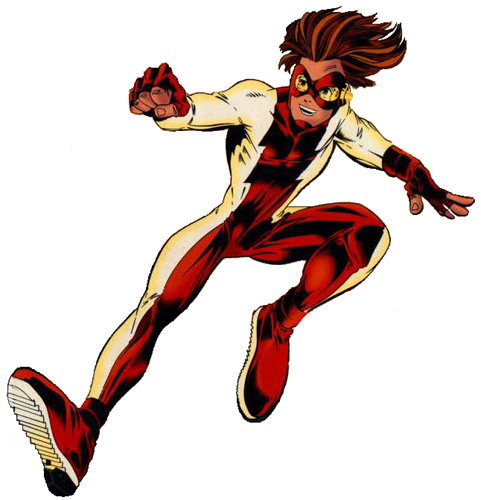
We cannot simply give him the multichannel sign of speeding-off-into-the-distance, because that could be used for all speedsters. We shouldn't really use Impulse or Kid Flash as that's his actual code name. I suppose the general public could trace the lightening logo on their chest, to mean Flash, and Kid Flash could be Flash+kid, but that isn't distinctive enough to mean Bart. I would be tempted to go with his big feet or his hair. No one else in the DCU has feet and hair quite like him, and I don't think he would be offended by it. You could sign big-feet-racing-forward and provide the lip pattern for Bart. I think that's fairly apt.
How about Speedy (Mia)?
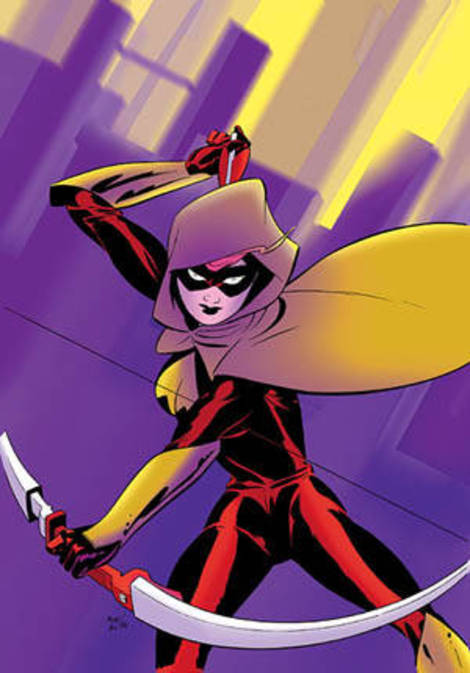
Well, you can't simply sign speedy, or fast, because in all honesty that is far more likely to be associated with the Flash type heroes in the DCU. Speedy's hero thing is her arrow shooting, but I find the sign for bow and arrow rather unwieldy, so would prefer not to use it. I also would prefer to choose something that would be distinct from RoySpeedy, so it needs to be feminised or be something completely different. Considering Mia's cocky personality I think I will go with the sign for Cheeky. I'm sure Ollie would agree.
Black Canary.

For her public name, I'd go with black+canary. Black is a thumbs up hand shape swiped along your cheek from near your ear to off your face by your mouth. Canary is a local sign in Norfolk, our football team is nicknamed the Canaries (these birds have a long association with the city, due to the influx of Dutch traders in earlier centuries). As such, both Canary and Norwich are the same - the bird sign over your left breast where the football logo is on a shirt.
As for her private name, for 80s hero Dinah we could trace the headband shape+name. For florist Dinah we could do flower+name. For a joke we could do computer+name. Although that might be best for Barbara. As a really boring sign we could do blonde+name, or martial arts+name.
Guy gets the bowl haircut sign, no question and no matter how long he's had a new style for. Batman has his own special sign for Guy though - falling over (as in being knocked out)+name.

The possibilities are endless!
Subscribe to:
Posts (Atom)